
The neuroscience behind every buying decision — and five ways to use it in your marketing, right now.
THE SCIENCE, IN PLAIN ENGLISH
For a long time, the prevailing assumption in marketing — and in business — was that people make rational choices. You present the right features, the right proof points, the right price, and the logical mind takes over. Convince the brain, close the sale.
Decades of neuroscience have dismantled that story almost entirely. The truer picture: we decide emotionally, then justify rationally. The brain is not a calculator deliberating to an output. It is, as neurologist Antonio Damasio’s research showed, a feeling machine that thinks.
“I continue to be fascinated by the fact that feelings are not just the shady side of reason — they help us reach decisions as well.” – Dr. Antonio Damasio, neurologist, USC
Damasio’s landmark work on patients with damage to the brain’s emotional centers was the turning point. These patients retained their reasoning abilities fully intact — but could not make even the simplest everyday decisions. Without emotion, the rational brain had no basis on which to act. Emotion isn’t the noise in the system. It’s the signal.
THREE MECHANISMS BEHIND EACH DECISION
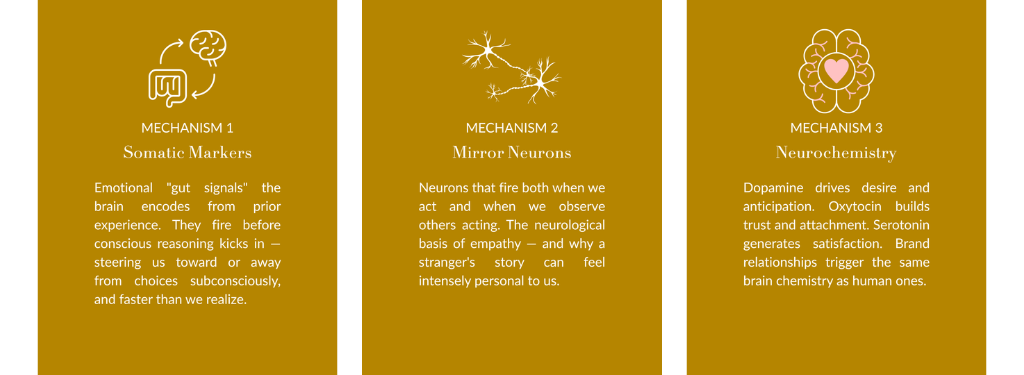
WHAT THE LATEST RESEARCH SAYS
>> JOURNAL OF MARKETING (Jan. 2026)
Your customers are telling you exactly how they feel — most brands aren’t listening at the right depth.
A new study published in the Journal of Marketing by researchers at WU Vienna introduces NADE (Natural Affect DEtection) — a tool that decodes consumer emotions from social media text by first translating language into emojis, then mapping those emojis to eight distinct emotional states: joy, sadness, anger, fear, surprise, anticipation, trust, and disgust.
The finding that matters for your brand: standard social listening tools measure whether sentiment is positive, negative, or neutral. That’s like reading a room and only knowing whether people are awake. NADE demonstrates that consumer emotions exist on a far more nuanced spectrum — and that brands relying on basic sentiment data are missing the emotional texture that actually drives behavior. Joy and anticipation are not the same signal. Trust and surprise require different responses. The emotion beneath the message is the message.
Practically: marketers who understand which specific emotion their content, campaigns, and customer interactions are generating — not just whether those emotions are “good” or “bad” — gain a meaningfully sharper picture of what’s working and why.
>> AMA MARKETING NEWS (Spring 2026 Future Trends Report)
The next five years will reward brands that lead with emotional resonance, not algorithmic reach.
AMA’s Spring 2026 Future Trends in Marketing report — developed with input from over 30 marketing professionals — identifies five forces reshaping the landscape. Two are especially relevant to emotional communications strategy.
- Consumer discovery is shifting to scroll. As search gives way to social feeds and AI interfaces, brands must create emotionally resonant, feed-optimized content. Rational, feature-led messaging gets skipped; content that feels something stops the scroll.
- Trust is the only remaining differentiator. In an era of AI-driven misinformation and fragmented communities, the AMA report identifies brand trust — earned through transparency, cultural fluency, and authentic participation — as the central competitive asset. The report envisions a future where “human meaning-making is the only remaining differentiator” that algorithms cannot replicate.
FIVE WAYS TO PUT THIS TO WORK
If emotion is the actual decision-maker, then your marketing’s most important job isn’t to inform — it’s to feel right. Here’s how to architect that, practically.

If you’re reading this and are thinking to yourself, “I love this but I don’t know where to start,” we encourage you to reach out to us. This is what we do!